A Place Name Walk for a Slow Autumn Afternoon
A place name walk helps you record map spellings, local forms and landscape clues on an autumn route, while keeping observation separate from guesswork.
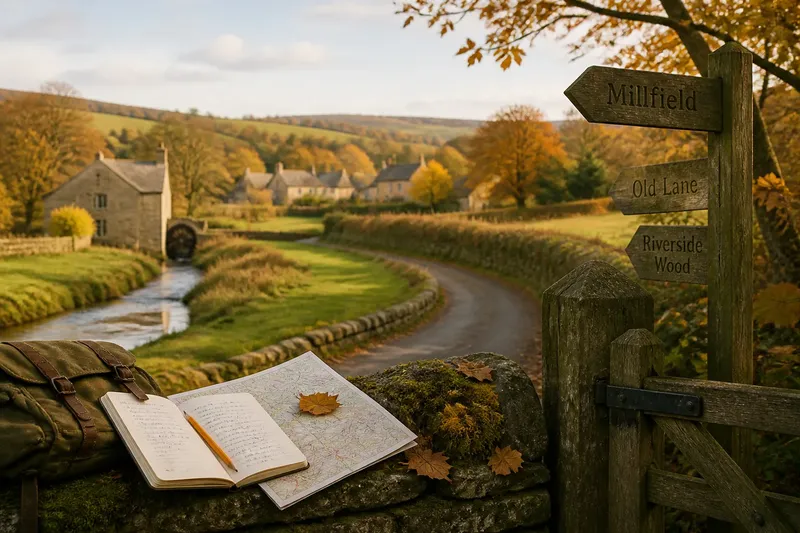
Where does a place name sit in the landscape, and what can you record without pretending to know what it means? A place name walk gives you a patient way to answer the first question and leave the second open. In autumn, when hedges thin and paths are quiet, a map and notebook can make a familiar lane feel newly legible.
What is a place name walk?
It is a short walk planned around names printed on a map or sign, rather than around a particular landmark. You notice where each name applies, how it is written, and what nearby features might help explain its location. You do not turn a sound into a confident translation.
That distinction matters. A name that resembles a familiar word may have a different origin, spelling history or local pronunciation. Treat it first as evidence of a name in use: record the form you saw, where you saw it, and what the surrounding ground was doing.
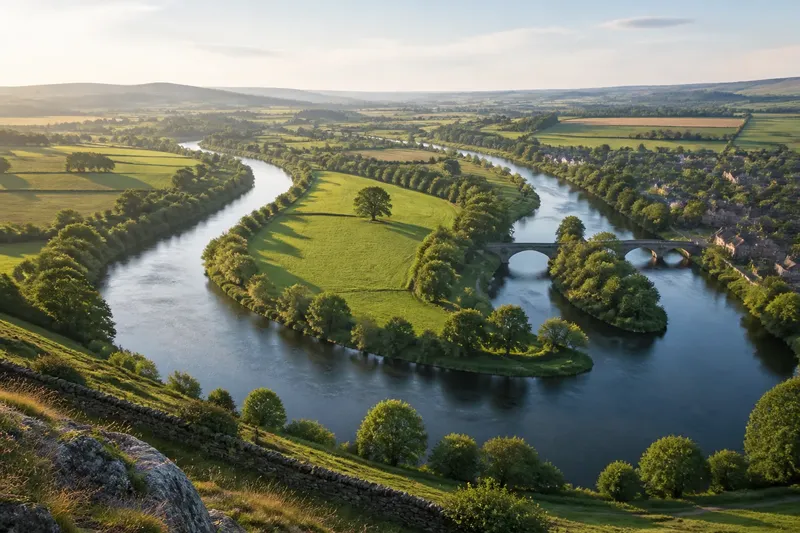
The walk is also a small exercise in county geography. A name can mark a settlement, a hill, a crossing, a wood or a patch of land whose edges are not obvious on the ground. The map gives one view; the path gives another. Neither needs to be forced into agreement.
How do you choose an autumn route?
Choose a familiar public route with a handful of names you can locate on an Ordnance Survey map or another reliable local map. A circular footpath near a village often works well: it may pass a lane, a stream, a farm, a wood and a hamlet without demanding a long excursion. Avoid planning around access you have not confirmed.
Autumn is useful because seasonal change can make certain features easier to notice. Fallen leaves may expose a ditch or bank; thinning foliage may reveal a church tower, a lane junction or the shape of a settlement. Mud, early darkness and slippery surfaces are less poetic, so choose a route and clothing suited to the conditions.
Mark a modest set of names before leaving. Include different kinds if the map offers them, such as a settlement name and a field, hill or water feature. Do not try to collect every label on the sheet. A walk with room to stop is better than a brisk hunt for names.
What should you take and record?
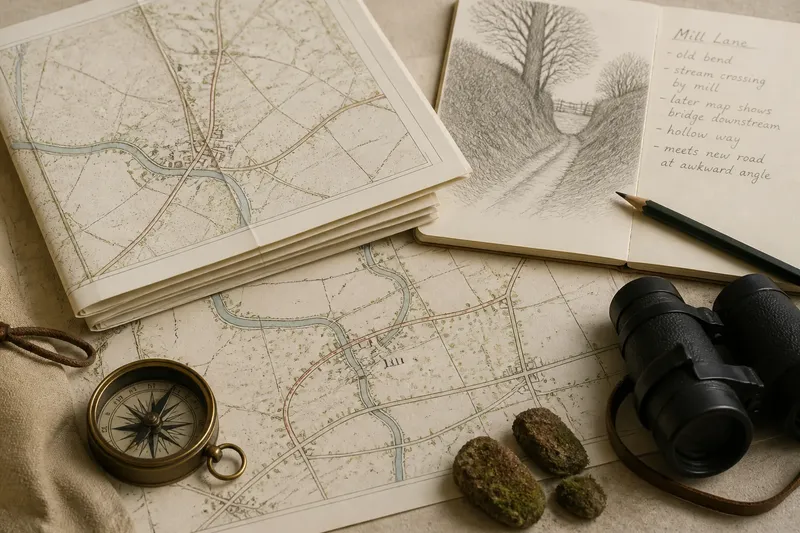
Take a paper map or an offline map on your phone, a notebook, a pencil and a camera if you use one. A pencil is practical in damp weather; a small notebook is less inclined to become a soggy umbrella with opinions. Keep the map usable without stepping into traffic or blocking a path.
For each name, make a separate entry. Use the following checks to keep the record clear:
- Map spelling: Check each letter and punctuation mark against the map. If the copy matches, record it as the map form; if not, recopy it or mark the uncertain characters rather than guessing.
- Location: Check whether you can identify a grid reference, junction or clear landmark. If you can, use that locator; if not, describe the nearby feature and leave the position approximate.
- Visible feature: Check what the label appears beside, such as buildings, a stream or a wood. If the feature is clear, describe it; if it is not, record the uncertainty instead of assigning the name to a specific object.
- Sign or notice: Check whether a local sign gives another form. If it does, copy it separately with the sign’s location; if not, leave the map form as the only observed spelling.
- Pronunciation: Check whether you actually heard someone say the name. If so, note the spoken form and who or what context supplied it without identifying a person; if not, do not infer pronunciation from spelling.
- Open question: Check whether you can tell if the name refers to a farm, lane or wider area. If you can only narrow it down, write the uncertainty; if you cannot, leave the scope unresolved.
- Photograph location: Check that each image can be linked to a place in your notes. If it can, record the location with the image; if it cannot, add the location while the walk is fresh or leave the photograph out of the record.
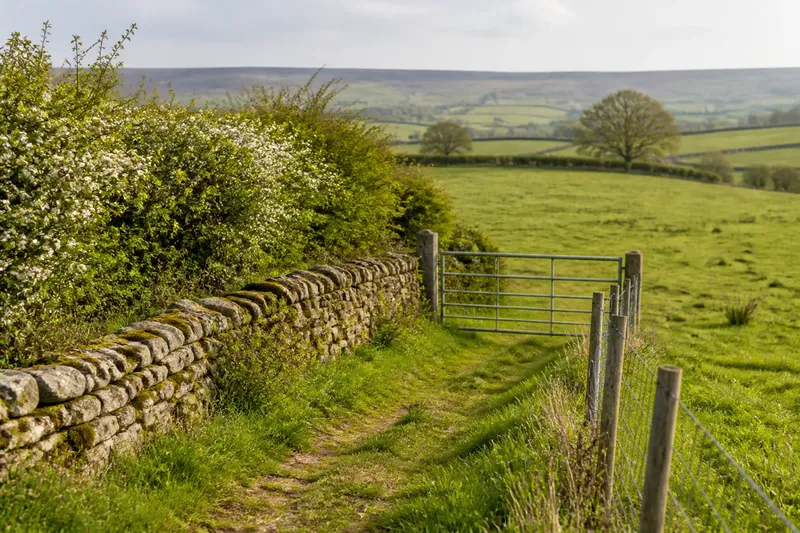
Photographs can help you remember a sign or view, but write down where each image was taken. A photograph of a gate without its location is an attractive puzzle, not a record. Avoid photographing people without permission, and do not enter private land to get a better angle.
How do map labels relate to the ground?
At each stopping point, look for the relationship between the printed name and the place around it. Does the label sit beside a stream, at a bend in the road, or over a cluster of buildings? Is there a boundary, rise or crossing that helps explain why the name belongs there? Record the relationship as an observation, not an origin story.
Map labels do not always point to a single object. A settlement name may cover several streets; a wood’s name may be printed beside only part of its edge. The label’s position is a cartographic choice, not necessarily a marker placed at the centre of the named area.
Say you have planned a walk past a place marked “Millfield” on your map. On the ground, you see a stream, a mill building that appears unused and fields, but no sign explaining the name. You copy the map spelling, note that the stream runs beside the fields and describe the building without claiming it gave the place its name. The resulting entry records the setting while leaving the connection unconfirmed.
Why avoid guessing a name’s meaning?
A familiar sound can mislead. Place names change through spelling, pronunciation and copying; a form that looks transparent now may preserve an older element, while an apparently obscure name may have a straightforward local history. Similar-sounding words are clues worth recording, not proof of meaning.
Keep interpretation separate from field notes. If a name reminds you of a word for a hill, stream or settlement, write “possible resemblance” in the margin and do not turn it into a definition. The walk can establish location and context; it cannot settle every linguistic question.
Local pronunciation deserves the same care. A spelling on a map, the form on a road sign and the way a resident says the name may differ. Record each source distinctly rather than silently correcting one to match another. The differences may reflect ordinary usage, older forms or simple inconsistency; the notebook need not decide which.
What questions help you read a place name walk?
Does the name refer to a settlement or the surrounding land?
Check where the map places the label and whether buildings cluster nearby. Note limits you can actually see, but do not assume the printed name ends at the last house.
Does a route or crossing help locate the name?
Record nearby lanes, bridges, fords or junctions and how they meet the named place. A route can explain why a location is easy to find without explaining how its name began.
Do signs and maps spell the name the same way?
Copy each form with its source, such as map, fingerpost or notice. Separate records make a disagreement visible instead of disguising it as a transcription mistake.
What can autumn reveal about the setting?
Note features that the season exposes, such as a bank beneath leaves or a building visible through thinner branches. Describe what you see on that day rather than treating seasonal visibility as permanent.
How should you organise notes afterwards?
At home, place each entry beside the relevant map extract or a clear reference to the map. Keep observations, copied forms and possible interpretations in separate columns or paragraphs. That simple separation works like labelled drawers: a spelling does not get mixed up with a guess about its history.
Check your notes for exactness while the walk is still fresh. Was the spelling copied from the map, or did memory supply it? Did you see the feature yourself, or infer it from the label? Correct uncertain details by marking them as uncertain; do not tidy doubt out of the record.
If you want to pursue a name’s history, consult a source that explains the forms it records. A county history, local archive, parish record or published place-name reference may offer useful context. Compare forms rather than relying on a single modern spelling, and preserve local variants instead of choosing a winner without evidence.
How can the next walk sharpen your notes?
Keep the first walk small and use its notes to choose a sharper question for the next one. You might return to check whether a label refers to a road or a group of buildings, or visit a different public path to compare how another settlement sits against its lanes and fields. The point is not to build a grand theory from a few afternoon observations.
A place name walk is useful when it leaves you with a better account of what is present and a more honest list of what remains unknown. Keep the map form, local forms and landscape observations distinct in your notes; that separation will still make sense when the autumn leaves are gone.