Hedge, Wall or Fence: Reading a Field Edge
Reading a field edge shows how hedges, walls and fences organise a county landscape, while separating visible features from uncertain property lines.
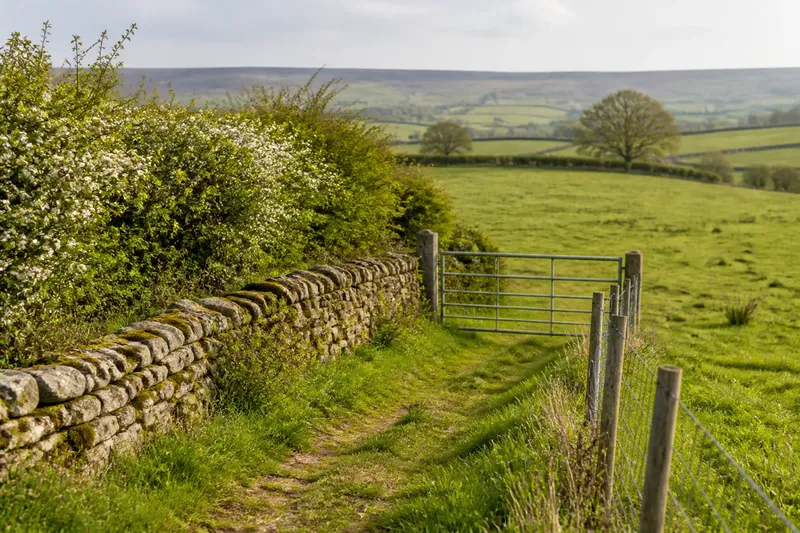
At a gate on a country lane, a hawthorn hedge may stop at a stone wall while a wire fence carries on across the pasture. Reading a field edge means describing what those features show—and resisting the temptation to treat them as proof of ownership.
What can a field edge tell you?
Hedges, walls and fences record practical choices about containing animals, sheltering crops, using local materials and managing access. They also change over time: a new fence can stand beside an older wall, or a hedge can grow over a bank.
For county geography, note the relationship between the feature and the apparent parcel shape. A boundary may turn towards a gate, skirt a wet hollow or run beside a ditch. A map and a view from a public path can help locate these details; neither automatically settles the legal line.
What does a hedge make visible?
A hedge is a living, uneven strip. Hawthorn, blackthorn and hazel are familiar plants in many rural hedges, though local species differ. Look for changes in density, gaps, a bank beneath the plants and any ditch alongside. Together, these details show how the edge is physically arranged.
Clipping, broad growth or a laid section can indicate different forms of management, but appearance alone does not identify who is responsible for the hedge. Record its course, composition and condition rather than assigning a history you cannot establish.
What does a wall reveal?
A wall makes its width and construction visible. Dry-stone work, mortar, a cap or a repaired section can all be noted. In upland areas, local stone may sit naturally among slopes and field patterns; in other places, brick or different materials may be used.
Repairs can complicate the apparent sequence. A newer stretch may follow an older course, while a low remnant beside a fence could be an earlier division or a convenient support. Describe the materials and their position before deciding what the arrangement means.
Height also affects how a field edge shapes a view. A high wall screens land; a low one leaves slopes and neighbouring fields visible. That difference can make similar parcel patterns feel enclosed or open.
Why choose a fence instead?
Wire, timber rails or mesh can contain animals while leaving sightlines open. Posts, braces and gates show how the fence is supported and where access is concentrated. Because fences are comparatively easy to replace, a visible run may follow an older division or mark a newer one.
Where a fence runs parallel to a hedge or wall, keep the features separate in your notes. The space between them might be a maintenance strip, an older edge retained beside a new barrier, or a practical way to keep stock away from fragile stonework. Record the gap without claiming to know its purpose.
Say you are walking beside a pasture where wire follows a low stone wall, then turns towards a gate. Your notes record the wall’s continuing course, the fence’s separate turn and the gate’s position. The result is a description someone else can check from the same public path, not a verdict about title.
How can you compare field edges?
Use observations that distinguish one arrangement from another. For each feature, check the detail and choose what to record according to what you see:
- Material: If the edge consists of plants, stone, timber or wire, record each material; if it changes along the route, note where the change begins.
- Course: If it runs straight, winding, stepped or in parallel lines, describe that shape; if the route is interrupted, mark the gap rather than assuming the edge continues.
- Height and visibility: If the feature screens the field, record it as a visual barrier; if the view passes through or over it, note that instead.
- Access: If a gate, gap or stile interrupts the edge, record its position; if there is no visible access point, describe the run as continuous from your viewpoint.
- Neighbouring features: If a ditch, track, bank, stream or slope follows the edge, record which feature lies beside it; if their courses diverge, describe both separately.
- Condition: If the feature is repaired, overgrown, collapsed or replaced, note the change; if it appears continuous, record that visible condition without inferring its age.
These observations make comparison useful across a county. A dense hedge beside a lowland lane and a stone wall on exposed upland ground may serve different practical needs. Like labels on jars, distinct notes stop two neighbouring features being mistaken for one.
What questions can reading a field edge answer?
Does a hedge mark the exact parcel line?
Not necessarily. A hedge identifies a visible strip, but the legal division may be described differently in records or other evidence. Note its position rather than treating its centre as a surveyed line.
Can a wall show who owns it?
Appearance alone cannot settle ownership. Construction and repair can provide context, but land records and, where needed, qualified professional advice are more relevant to a legal question.
Why is there a fence beside a hedge?
The barriers may serve different purposes, or one may have been added while the other remained. Record their spacing, direction and points of connection; the reason for their arrangement may not be visible.
What should I record when the material changes?
Note where the change occurs and whether the route continues in the same direction. A transition from hedge to wall is observable; its cause may not be.
Where should interpretation stop?
If a boundary is disputed or ownership matters, consult relevant land records and seek suitable professional advice. A roadside observation is useful for describing a landscape, not for settling a legal question.
Reading a field edge is most useful when the notes distinguish the hedge, wall or fence from the parcel division it appears to mark. That distinction leaves room for the county’s visible patterns without asking a row of hawthorn to serve as a title document.